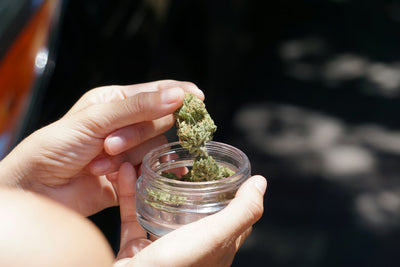
PA Legalization Hinges on 3 Senate Seats, Speaker Says
Photo by Katherine McAdoo via Unsplash.
Pennsylvania's marijuana legalization debate has been reduced to arithmetic. House Speaker Joanna McClinton told a room full of cannabis entrepreneurs and advocates in Philadelphia on Sept. 25 that the path to adult-use legalization isn't through another round of negotiations or a cleverly worded compromise bill -- it's through flipping three state Senate seats in November. That's a notably blunt admission from the state's top House Democrat, and it says something about how stuck Harrisburg has become on this issue.
Pennsylvania sits in an increasingly odd position on the map. New York, New Jersey, Delaware, Maryland and Ohio have all legalized adult-use cannabis, which means the Keystone State is now fully surrounded by legal markets on every border. The House already did its part, passing a legalization bill earlier this year. The real obstacle has always been the narrowly Republican-held Senate, and McClinton's comments make clear that Democrats see November's elections -- with all 50 Senate seats and all 203 House seats on the ballot -- as the moment that could finally reshape the math in their favor.
What McClinton Actually Said

Photo via Unsplash.
McClinton made her remarks at the Cannabis Opportunities Conference, held during Black Cannabis Week in Philadelphia on Friday, Sept. 25. Speaking to an audience of industry operators, advocates and entrepreneurs, she didn't sugarcoat where Pennsylvania stands relative to its neighbors, saying the state has a ways to go to catch up with states that have moved in the right direction on legalization. That's a notable phrase from someone in her position -- an acknowledgment that Pennsylvania isn't just lagging, it's watching tax revenue and consumer traffic drift across state lines to places that already figured this out.
The more pointed line came when she described what actual change would require. What it looks like for us to have change is we have to change who is making the laws in that chamber, she said, referring directly to the state Senate. That's not a call for more bipartisan outreach or another compromise framework -- it's a statement that the current Senate, as composed, isn't going to pass legalization no matter how the bill is written. McClinton is essentially telling the industry that the legislative session's remaining window isn't where the real opportunity lies. November is.
The Senate Math: Why Three Seats Matter

Republicans currently hold a 27-23 majority in the Pennsylvania Senate, but if Democrats flip just three seats in November, the balance would shift to a 26-24 Democratic majority.
The numbers explain why McClinton is talking about elections instead of amendments. Republicans currently hold 27 of the Pennsylvania Senate's 50 seats, with Democrats holding 23. A net gain of three seats for Democrats this November would flip the chamber to a 26-24 Democratic majority, which would be enough to change who controls committee assignments, floor scheduling and which bills even get a vote.
Every one of the Senate's 50 seats and all 203 House seats are up this cycle, which is unusual timing that gives both parties a full reset opportunity rather than the partial turnover you'd see in a typical midterm-style cycle for a state chamber. That's a lot of volatility to track, and it means the current 27-23 split is genuinely up for grabs rather than locked in by staggered terms.
Worth noting: even a full Democratic flip wouldn't guarantee legalization sails through. Bills like Sen. Sharif Street's SB 120 were built as bipartisan efforts specifically because Democrats knew they'd need Republican votes in a GOP-controlled chamber. If Democrats do flip three seats, they'd still likely need to hold their own caucus together on a genuinely contentious issue, and recent history in Harrisburg suggests that's not automatic. A 26-24 majority is thin, and thin majorities lose votes over the details -- state-run stores versus private licensing, tax rates, social equity provisions -- just as often as they lose them over party lines.
How the House Bill Stalled in the Senate
The House did pass a legalization bill this year. HB 1200, which would establish a state-run retail model similar to Pennsylvania's existing liquor store system, cleared the Democratic-controlled House in May 2025 by a 102-101 vote -- a margin so narrow it left no room for defections and signaled just how politically fraught this issue remains even among Democrats.
The bill's momentum died almost immediately after crossing to the Senate. The Senate Law and Justice Committee tabled HB 1200 within days, voting 7-3 to shelve it rather than schedule hearings or amendments. That's the kind of procedural move that effectively ends a bill's life for the session without forcing anyone to cast a politically uncomfortable floor vote.
In response, Sen. Sharif Street filed a discharge resolution -- signed by every Democratic senator in the chamber -- aimed at forcing his own bipartisan legalization bill, SB 120, out of committee and onto the floor regardless of what committee leadership wanted. That unanimous Democratic signature is itself notable; it shows the caucus is unified on wanting a vote, even if they disagree on legalization's exact structure. SB 120 has a Republican co-sponsor in Sen. Dan Laughlin, who chairs the Law and Justice Committee, which should theoretically help its odds. But Laughlin has instead prioritized a competing bill of his own, leaving SB 120 stalled despite having bipartisan authorship.
The Cannabis Control Board Fight and Shapiro's Role

Photo via Pexels.
Laughlin's preferred bill, SB 49, took a narrower approach than full legalization -- it would have shifted oversight of Pennsylvania's medical marijuana program away from the Department of Health and handed it to a newly created seven-member Cannabis Control Board. The idea was popular among Republicans, who largely backed it, but it collapsed on the Senate floor when all but two Democrats voted against it, denying it the votes needed to pass.
Laughlin pointed a finger at Gov. Josh Shapiro for the bill's defeat, suggesting the governor's office worked against it behind the scenes. The Senate then adopted a motion to reconsider, technically keeping SB 49 alive, but no timeline has been set for another vote, leaving it in the same kind of limbo as everything else on this topic in Harrisburg.
Shapiro's own position adds another layer of tension. He's included comprehensive adult-use legalization in three consecutive budget proposals, including his 2026-27 plan, treating it as a revenue line item as much as a policy priority. Yet when he signed the state's $50.8 billion budget on July 12, legalization was nowhere in the final package -- another example of the idea polling well in speeches but disappearing when actual votes get counted. Senate Majority Leader Joe Pittman has been blunt about why: he's said he simply doesn't see support for legalization within his own Republican caucus, which is about as clear a signal as you'll get that this isn't happening through the current Senate as constituted.
Why Pennsylvania Is the Regional Outlier
Pennsylvania's geography makes its holdout status increasingly conspicuous. New York, New Jersey, Delaware, Maryland and Ohio have all legalized adult-use marijuana, meaning Pennsylvania is bordered on every side by legal markets. Residents in Philadelphia, Pittsburgh, or anywhere near a state line can drive a short distance, buy legally, and drive home -- while Pennsylvania collects none of the tax revenue and none of the licensing fees that come with building an in-state industry. That's the practical argument McClinton and other legalization advocates keep coming back to: this isn't really a debate about whether cannabis will be available to Pennsylvanians, since it already effectively is. It's a debate about whether the state captures any of the economic activity.
The setting for McClinton's remarks wasn't incidental, either. Black Cannabis Week and the Cannabis Opportunities Conference are explicitly focused on equity and access within the cannabis industry, and tying her comments to that audience frames legalization as an economic opportunity question as much as a criminal justice or public health one -- who gets licenses, who gets capital, who gets left out if Pennsylvania waits even longer while neighboring markets mature.
Meanwhile, the state's existing medical marijuana program continues to operate under Department of Health oversight, its regulatory structure unresolved and tangled up in the same Senate gridlock that's stalling adult-use legalization. Until the Senate's composition changes or its priorities shift, both the medical program's oversight question and the broader legalization question are stuck in the same holding pattern. As always, anyone following this closely should check current Pennsylvania law directly, since the legal landscape here is actively in flux and could shift depending on what happens in November.
Strip away the diplomatic phrasing and McClinton's comments amount to something close to a concession: years of trying to persuade the current Senate to pass legalization haven't worked, and the strategy has shifted from legislative negotiation to electoral turnover. That's a meaningful admission from a sitting House Speaker, because it implicitly acknowledges that bipartisan bill design, discharge resolutions, and budget proposals stuffed with legalization revenue projections haven't been enough to move Republican leadership off its current position.
But it's worth resisting the assumption that a Democratic Senate majority would immediately solve this. HB 1200 passed the House by a single vote, on a strict party line, which is hardly the sign of a caucus with room to spare on a contentious policy question. A 26-24 Democratic Senate would face the same dynamic -- one or two defections on a state-run-stores model, a licensing dispute, or a tax rate disagreement could sink a bill just as easily as Republican opposition does now.
The real test comes in November. Watch the swing Senate districts where three seats could plausibly change hands -- those results will tell you far more about 2027's prospects than anything said at a conference podium in Philadelphia. If Democrats don't flip that chamber, expect another year of tabled committees and reconsideration motions. If they do, expect the fight to shift from whether Pennsylvania legalizes cannabis to what exact model survives a caucus vote -- which, based on this year's history, is no small hurdle either.
Sources
- Pennsylvania House Speaker Says November Senate Elections Could Clear Path for Marijuana Legalization in 2027
- Daily Cannabis News Brief for 9/25/2026
- Pennsylvania Democratic Party
- Pennsylvania Governor Should Lead On Marijuana Legalization By Convening Bipartisan Lawmakers For Negotiations, Advocates Say - Marijuana Moment
- Pennsylvania Can Legalize Marijuana Next Year If Democrats Flip Three Legislative Seats, House Speaker Says - Marijuana Moment