Poll: Cannabis Stances Will Sway Most Voters This November
Photo by Edmond Dantès via Pexels.
Ask a campaign strategist how much cannabis policy matters to voters and you'll likely get a shrug. A new poll suggests that shrug is a mistake. NuggMD, the telehealth platform, teamed up with NORML to survey 654 cannabis consumers in legal-market states, and the results landed just as both parties start locking down their closing messages for November: nearly 8 in 10 respondents say a candidate's stance on cannabis will shape who gets their vote next month.
That's not a fringe number, and it's not a partisan one either. Democrats and Republicans in the sample both said cannabis policy matters to their vote, at rates that would make most single-issue voting blocs jealous. The timing couldn't be sharper. Massachusetts voters are deciding whether to roll back a legal market that's been operating for years, Idaho voters are being asked whether they should even keep the right to vote on this issue at all, and the federal rescheduling process that was supposed to move cannabis off Schedule I has stalled out in Washington. Put those threads together and you get a pretty clear signal: candidates who treat cannabis as a side issue may be misreading exactly the people deciding their races.
What the Poll Actually Found

Photo by Edmond Dantès via Pexels.
The numbers come from a survey NuggMD conducted on behalf of NORML, released October 20, 2026, polling 654 cannabis consumers living in states with legal markets, with a margin of error of plus or minus 3.83 percentage points. The headline finding: 41% of respondents said candidates' cannabis policy positions will significantly influence their vote, another 37% said it will somewhat influence their choice, and only 22% said it won't affect their decision at all. Add those first two groups together and you're at roughly 78% of legal-market consumers saying cannabis policy is a real factor in the voting booth this cycle.
What's notable isn't just the size of that number but how evenly it's distributed across party lines. Among Democrats surveyed, 83% said candidate positions on cannabis will influence their vote. Among Republicans, 73% said the same. That's a 10-point gap, sure, but it's a gap between two large majorities, not a split between a majority and a minority. The gender breakdown tells a similar story of consensus rather than division: 81% of women and 76% of men said cannabis stances matter to their vote, a difference small enough to fall within normal polling noise.
NORML Deputy Director Paul Armentano put it plainly in comments on the findings, noting that reforming marijuana prohibition laws enjoys broad, bipartisan support among voters and that candidates who ignore that reality do so at their own political peril. That's not spin from an advocacy group trying to inflate its own relevance -- it's a reasonable read of a poll showing consumers across the political spectrum treating this as a litmus-test issue rather than a tiebreaker they'll only consider after everything else.
Patience With Washington Is Running Out

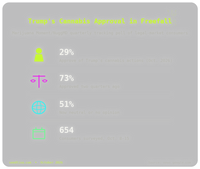
Approval of federal marijuana policy action has plunged sharply over the past three quarters, dropping from 73% to just 29%.
A separate, ongoing NuggMD and Marijuana Moment tracking poll that checks in quarterly on how voters feel about the Trump administration's handling of marijuana policy shows something that should worry anyone hoping voters will cut Washington slack on this issue. Approval has collapsed. Just 29% of respondents now approve of how the administration is handling marijuana, down from 48% last quarter and a startling 73% two quarters before that. That's not a dip -- that's a freefall spanning roughly six months.
The timing lines up almost exactly with the stalling of the DEA's rescheduling process, the long-promised move to shift cannabis off Schedule I under the Controlled Substances Act. That process has been bogged down for months in procedural fights over the administrative hearing record. The DEA recently signaled it's open to reopening that record to include a key government report, but opponents of rescheduling are pushing for something far broader: new testimony, new discovery, and a fuller reopening that would push any resolution well past where it currently sits. Every delay adds months, and every month adds to a sense among consumers that promises made aren't promises kept.
That combination -- a process many assumed would be resolved by now, paired with cratering approval numbers -- suggests the frustration isn't abstract. Voters who feel strung along on rescheduling appear to be channeling that directly into how they plan to vote in November, which is exactly the kind of dynamic that turns a regulatory delay into a political liability for whoever voters associate with the inaction.
Massachusetts Voters Likely to Reject Repeal

Photo via Pexels.
Massachusetts legalized adult-use cannabis by ballot initiative back in 2016, and this November voters there are being asked whether to undo it. Question 8 would repeal the production, sale, and home cultivation of adult-use marijuana in the state. Medical marijuana wouldn't be touched either way -- that program stays intact regardless of the outcome -- but the recreational market that's grown into a multi-billion-dollar industry over the past decade would be dismantled if the measure passes.
Two independent polls suggest that's not going to happen. A UMass Amherst survey conducted with WCVB-TV found only 31% of respondents favor repeal, while a Suffolk University poll done in partnership with the Boston Globe found 71% opposed to Question 8. Those are two different polling outfits using two different methodologies arriving at essentially the same conclusion: a strong majority of Massachusetts voters want to keep the adult-use market they approved a decade ago.
What makes this worth watching isn't just the likely outcome but what it says about durability. Legalization campaigns often win close votes built on momentum and novelty. A repeal effort failing by a 2-to-1 margin roughly ten years after the original vote suggests something more settled -- that voters who've lived alongside a functioning adult-use market aren't eager to tear it down, even when given a direct, up-or-down chance to do so. Readers in Massachusetts should still confirm ballot language and polling place details before Election Day, since initiative campaigns can shift in the final stretch.
Idaho's Fight Over Who Gets to Decide

Photo via Pexels.
Idaho's ballot fight looks nothing like Massachusetts's, and that's the point. There's no functioning adult-use or even medical market to defend or repeal in Idaho -- it's one of the few states in the country with no medical cannabis program of any kind. Instead, voters there face HJR 4, a legislature-referred constitutional amendment that would strip Idaho citizens of the power to legalize marijuana, or any controlled substance, through a ballot initiative. If it passes, only the state legislature would have the authority to authorize cannabis legalization in Idaho going forward, full stop.
That measure isn't happening in a vacuum. Advocacy groups in Idaho are simultaneously gathering signatures for a separate Medical Marijuana Legalization Initiative that would establish a limited patient registry, the kind of modest, narrowly tailored medical program that dozens of other states adopted years ago. HJR 4, if approved, would effectively close that door for good, shifting all future decision-making to a legislature that has shown little appetite for cannabis reform.
That's what makes Idaho's election genuinely different from most cannabis ballot fights happening elsewhere this cycle. Voters there aren't just being asked whether they want legal weed. They're being asked whether they, as citizens, should keep the right to even have that conversation through the ballot box in the future. It's a vote about process as much as policy, and it's worth watching closely regardless of where you stand on legalization itself, since the outcome will shape how cannabis policy can change in Idaho for years to come.
Why This Matters Beyond November

Photo via Pexels.
Step back from the individual ballot measures and a broader pattern comes into focus. Polling showing nearly 8 in 10 legal-market consumers factoring cannabis into their vote, with majorities in both parties saying the same, isn't the profile of a niche issue anymore. It's the profile of something candidates dodge at real cost, particularly in close races where a few percentage points of a motivated bloc can decide the outcome.
The ballot fights themselves show how the terrain has shifted. Massachusetts isn't debating whether to legalize -- it's debating whether to claw back a right voters already granted themselves. Idaho isn't debating legalization directly -- it's debating who gets to make that call in the first place. Neither state is relitigating the basic question of legalization versus prohibition anymore; they're fighting over rollback and control, which is a different and in some ways higher-stakes kind of fight.
Layer the stalled federal rescheduling process and the collapsing approval numbers on top of that, and the pressure isn't confined to presidential politics. It touches governors, state legislators, attorneys general, and members of Congress running this cycle, since voters frustrated with federal inaction don't necessarily draw a neat line between who's responsible and who isn't. As always, cannabis laws and ballot measures vary significantly by state, and poll numbers can shift in the final weeks of a campaign, so anyone planning to vote on these issues should verify the current status of local measures and candidate positions before heading to the polls.
What this polling really captures is a quiet shift in how cannabis functions politically. It's stopped being a wedge issue that one party uses to court younger voters while the other avoids it entirely. It's become something closer to a durable, bipartisan expectation -- the kind of issue where ignoring it doesn't win you points with a base, it just loses you voters across the spectrum who've decided this is a line item they're actually checking before they fill in a ballot.
Polling is still just polling, though. The real test lands on November 3, when Massachusetts voters either uphold or dismantle a decade-old market and Idaho voters decide whether they keep the right to make that kind of decision themselves at all. Both outcomes will say more about where the country actually stands than any survey can.
Candidates who keep treating cannabis policy as an afterthought, something to mention briefly and move past, are increasingly betting against the people who'll decide whether they're still in office come December. Based on what these consumers are saying, that's not a bet with great odds.
Sources
- Poll: Candidates' Views on Cannabis Policy Will Play a Role in Voters' Decisions This November Poll: Candidates' Views on Cannabis Policy Will Play a Role in Voters' Decisions This November
- Candidates' Views on Cannabis Plays Role in Voters' Decisions
- Most Marijuana Consumers Will Decide Who To Vote For In Next Month's Elections Based On Candidates' Cannabis Stances, Poll Shows - Marijuana Moment
- Poll Finds 78% of Marijuana Consumers Say Candidates' Cannabis Policies Will Influence Their Votes in November
- Pennsylvania elections are coming, and cannabis is on the ballot!