Mapping Autoflower1: Breeding Autos Without Ruderalis
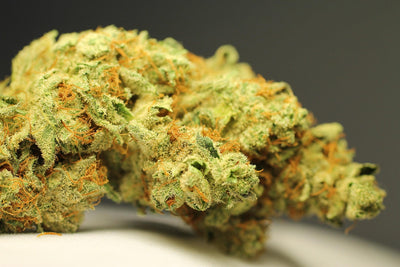
Photo by Jhon David via Unsplash.
Autoflowers are the easiest plants in the garden. They flower on a clock set by age, not by the light schedule, so a grower can run them under a long-day light schedule from seed to harvest and skip the flip entirely. They also carry a reputation problem in any conversation about potency, and the usual explanation is a scrappy wild ancestor.
The question this piece asks is narrow. If the trait really sits at one locus, as early mapping work suggests, can a breeder move it into an elite high-THC background without hauling the rest of that ancestor along? That is the promise behind the phrase ruderalis-free, and the promise is bigger than the evidence behind it.
A word on how this article is organized. Published findings, such as a mapping result and a candidate gene, are labeled as findings. Reasoned extrapolation from other crops and from breeding arithmetic is labeled as extrapolation. Anything about commercial products or timelines is open speculation, and it is the least verified part of the whole story. Where I could not confirm a detail, such as an author list or the size of a mapped region, I say so and leave it out.
Key takeaways
- Autoflowering has been mapped to a region on chromosome 1, and a PRR37-type clock gene has been proposed as the candidate.
- PRR37 genes control photoperiod flowering in sorghum and barley, which makes the cannabis candidate biologically plausible but not automatically proven.
- Marker-assisted backcrossing could recover most of an elite photoperiod parent's genome over several generations while keeping the autoflower trait.
Why Autoflowers Carry Ruderalis Baggage
Day-neutral flowering in cannabis is generally traced to Cannabis ruderalis populations from short-summer, high-latitude regions of Central and Eastern Europe and Russia. Think about the selection pressure there. A plant that waits for the days to shorten may run out of season before it sets seed, so flowering on a developmental timer is a sound survival strategy. Plants that flowered on age left more descendants.
That much is the biology. The established fact on the breeding side is that early commercial autoflowers were built by crossing ruderalis with photoperiod drug-type plants and then selecting offspring that flowered on age rather than on light. The trait was the target. Everything else in the ruderalis genome came along for the ride.
Here the reasoning turns from fact to extrapolation. Ruderalis is also associated with low THC and small flowers, and early crosses presumably inherited that package. It is a fair explanation for why autoflowers earned a name for weaker potency, though I would hold it as a likely story, not a measured result.
The mechanism that makes the story plausible is linkage drag. Genes sitting physically close together on a chromosome tend to be inherited as a block, because recombination rarely separates close neighbors. If the DNA that causes autoflowering sits beside DNA that affects flower size or cannabinoid output, selecting for the first means dragging the second along. Breeders can only break that block by growing enough offspring to catch the rare recombinant.
Now the counter-case, and it matters. Modern autoflowers have been bred up over many generations, and breeders have crossed them back into potent photoperiod stock again and again. The gap between a current autoflower and a current photoperiod cultivar may be much smaller than the reputation suggests. I have no sourced figure for a fixed THC penalty, so I will not assert one. What the history supports is narrower: the early packaging was poor, and the question is how much of that packaging still remains.
What Mapping a Locus Actually Means

Photo by Pavel Danilyuk via Pexels.
Genetic mapping sounds abstract, but the logic is simple. You cross an autoflowering parent with a photoperiod parent and grow out the offspring. You record which plants flower early. Then you scan their DNA for markers, small known differences in the sequence, and look for the ones that consistently travel with the early-flowering plants. The markers that line up point to the neighborhood where the trait lives.
A published mapping study placed autoflowering on cannabis chromosome 1, and the region has been referred to as Autoflower1. I am describing that result from recollection and not from a retrieved paper, so I am not naming the authors, journal, year or the size of the interval here. Check the primary paper before you quote any of those details, and treat any secondhand summary, including this one, as a pointer and not a citation.
The inheritance pattern commonly described for the trait is recessive. That fits what breeders see in the garden: cross a photoperiod parent to an autoflower and the first generation (the F1) comes out photoperiod, because one working copy of the dominant version is enough to keep the light-dependent behavior. The autoflowering plants only reappear when two copies of the recessive allele come together, usually in the F2 or in a backcross to the autoflower parent. That pattern also needs confirming against the paper itself, since a clean recessive story can hide complications.
The distinction that matters most for everything that follows is between a mapped interval and an identified gene. A mapped interval is a stretch of chromosome that statistically contains the cause. Depending on how many recombination events the cross captured, that stretch can hold dozens of genes. Naming one of them as the cause is a much higher bar, and it requires different evidence.
I have no verified figure for how wide the Autoflower1 interval is, and the article will not invent one. That gap is not a minor footnote. The width of the interval determines how tightly a marker can follow the allele and how much neighboring DNA is likely to travel with it, which are the two things a breeder cares about most.
The PRR37 Candidate and Its Crop Precedents
Later work proposed a pseudo-response regulator gene, which I recall as CsPRR37, as the candidate behind Autoflower1. I cannot confirm the authors, the journal or the exact gene name from the sources in hand. I also cannot say whether the paper calls it a candidate or a confirmed cause, and that difference decides how much weight the claim can carry. Candidate is the safer reading until you have seen the functional evidence.
The reason a PRR gene is a sensible suspect comes from other plants. In Arabidopsis, PRR genes are part of the circadian clock, the internal timer plants use to read day length. In sorghum, a PRR37 homolog sits at the Ma1 locus, a major controller of photoperiod sensitivity. In barley, the Ppd-H1 gene is likewise a PRR homolog that governs how the plant responds to long days. These are documented precedents, and they share a pattern: change the clock gene and the flowering schedule moves.
That is what the precedent supports. Flowering by day length in cannabis is almost certainly a clock-linked trait, so a clock gene falling inside a flowering-time locus is a reasonable bet. Loss-of-function alleles that shift flowering time are a recurring theme in crop domestication, which makes a recessive autoflower allele at a PRR gene easy to imagine.
What the precedent does not do is prove anything about cannabis. Similar function in another species is a hypothesis, not a result. Settling causation would take functional tests: editing the gene and watching the phenotype change, or complementing a mutant with a working copy and watching it revert. Cannabis transformation is difficult, which is part of why such tests lag behind the mapping.
The conservative counter-case deserves real attention. Flowering time is polygenic in most crops. One gene may explain a large share of the autoflowering behavior without explaining all of it, and modifier loci could tune how early or how rigidly a plant flowers. If that holds in cannabis, a breeder who tracks only the PRR region may still see variation in flowering timing that the single marker does not predict.
The Breeding Playbook: Marker-Assisted Backcrossing

The recurrent-parent genome share rises quickly at first, from 75% at BC1 to about 94% by BC3, but gains shrink each generation and plateau near 99% by BC6.
If the locus is as tractable as early work suggests, the textbook method is marker-assisted backcrossing. You start with an elite high-THC photoperiod line as the recurrent parent. You cross in the autoflower allele from a donor, then backcross to the elite line generation after generation. At each step you use DNA markers to pick plants that carry the allele and also have the least donor DNA everywhere else.
The arithmetic here is not speculation. Each backcross halves the donor genome that remains. As a theoretical average, before any marker selection speeds things up, the recurrent parent's share looks like this:
| Generation | Recurrent-parent genome (average) |
|---|---|
| F1 | 50% |
| BC1 | 75% |
| BC2 | 87.5% |
| BC3 | 93.75% |
| BC4 | 96.9% |
| BC5 | 98.4% |
Markers can beat those averages by selecting individuals that happen to have inherited more of the elite genome than the mean. Still, the table shows why the process takes patience: the last few percentage points of donor DNA take the most generations to remove.
The recessive inheritance adds a wrinkle. In a backcross to the photoperiod parent, the offspring carrying the allele look photoperiod, because the dominant version masks it. So breeders either self or intercross after each backcross to expose the trait, or they lean on markers to track the hidden allele. Both routes add generations, and cannabis cycle time is measured in months, not weeks.
The speculative read is this. With reliable markers, a program might reach a near-isogenic autoflower version of a proven cultivar in a few years. That is an assumption built from the arithmetic and from how backcross programs work in other crops, not a documented timeline for cannabis, and real programs routinely run slower than plans.
The counter-case is built into the method. The autoflower allele itself came from a ruderalis background, so small ruderalis segments around the locus will remain no matter how many times you backcross. Ruderalis-free should therefore be read as ruderalis-minimized unless someone shows sequence data proving otherwise.
What Could Stall the Ruderalis-Free Promise

Photo by CannabisVera via Pixabay.
Start with linkage drag running the other way. If the autoflower allele sits close to genes that affect cannabinoid synthesis, resin production or yield, tight linkage could make clean separation slow, because the recombinants that break the block are rare. The research brief has no verified data on what lies near the locus, so I cannot say whether this is a real obstacle or a theoretical one. It is the first thing a serious program would check.
Second, the commercial claims. No source in the material behind this article confirms that any named breeder sells high-THC autoflowers with no ruderalis ancestry. Seed marketing is full of confident lineage statements, and the category has no independent verification norm. Until a seller shows genotype data, such as markers across the genome and sequence around the locus, treat the claim as unvalidated copy.
Third, agronomy, which no amount of genetics fixes. A day-neutral plant flowers on a fixed developmental clock, so it cannot be held in vegetative growth to build a big frame the way a photoperiod plant under a long-day schedule can. That caps yield per plant. Autoflowers can compensate with more plants per square meter or faster turnover, but the per-plant ceiling is a structural trade-off.
So here is the hardest question for the optimists. Will potency, terpene depth and yield, not just THC percentage, match elite photoperiod cultivars in side-by-side trials? A lab number for THC is easy to print on a label. Terpene profile and total harvest weight are what growers and consumers actually notice, and those depend on many genes spread across the genome, not one locus on chromosome 1.
Finally, there is a research-access problem. In the United States, restrictions on interstate shipment of cannabis and limits on federal funding have historically slowed academic field trials. Replicated multi-site trials are exactly what this question needs, so validation may take longer than the molecular work. That is an institutional drag, and it falls hardest on the public-sector science that would produce neutral data.
Where the Opportunity Opens Up, and What to Watch
Now the opportunity, and I flag it as speculative but reasoned. If breeder-ready markers become available, seed companies could screen seedlings at the cotyledon stage instead of growing every plant to flowering. Breeders in other crops already do this, because a leaf punch and a DNA assay cost far less than a greenhouse slot. In cannabis that could cut the cost per selected line and make the generation-heavy backcross program above more affordable.
Three markets look plausible for high-potency autos. High-latitude outdoor growers with short summers are the natural fit, echoing the very conditions that shaped ruderalis. Multi-harvest indoor operations that run without strict light-cycle control are another, since a single light schedule simplifies room design. Hemp growers who want uniform flowering time across a field are a third. Each is an inference from how the trait behaves, not a market I can size, and I will not attach a number to any of them.
The precedent for the commercial path is marker-assisted selection in crops such as maize and rice, where it became standard after key loci were mapped. That suggests a route from locus to product that cannabis could follow. The friction here is different, though: patents on markers or alleles, legal fragmentation across states and countries, and limits on moving germplasm could keep the tools proprietary and slow their spread.
If you want a watch list, keep it short:
- Peer-reviewed functional validation of PRR37 or another gene, through editing or complementation, not just association.
- Whether markers are released publicly or locked behind patents.
- Independent potency, terpene and yield data from side-by-side trials.
One caution on all of the above. The details here come from recollection of the mapping and candidate-gene papers, and any 2025 or 2026 follow-up could change the forecast. A validated causal gene, or a published marker set, would move several of these projections from speculation toward plan. Search PubMed and bioRxiv for autoflowering, Autoflower1, PRR37 and cannabis photoperiod before you rely on any of it.
The real test of a ruderalis-free autoflower is a genome and a harvest, not a label. Ask for sequence data across the locus and the genetic background, and look for side-by-side trials against the elite photoperiod parent. A breeder who can show both has earned the claim. One who can show neither is selling a story.
If the locus is as simple as early work suggests, the bottleneck moves from discovery to the slow, unglamorous work of backcrossing and testing. Generation times in months, recessive alleles that hide, and linked DNA that resists separation all favor patience over announcements. The winners are more likely to be the programs holding the best elite parents than the first to publish a gene, because a clean allele dropped into mediocre genetics is still mediocre.
Sources
- Comparative genomics of flowering behavior in Cannabis sativa - PMC
- (PDF) Identification and mapping of major-effect flowering time loci Autoflower1 and Early1 in Cannabis sativa L.
- (PDF) Comparative genomics of flowering behavior in Cannabis sativa
- Frontiers
- Introduction
- Identification and mapping of major-effect flowering time loci Autoflower1 and Early1 in Cannabis sativa L