Cannabis in Traditional Celebrations Around the World
Photo by Bhavy Ahuja via Pexels.
Thandai at Holi may or may not contain bhang, and that single ingredient decides whether a seasonal drink is also a legal question. The same plant sits on international control schedules and is a controlled substance in most national legal systems.
In India, Nepal, Jamaica, Morocco and Thailand, cannabis was part of social, religious or hospitality customs well before modern drug policy existed, and statute and custom now overlap awkwardly.
This is a cultural overview, not legal advice, and cannabis law changes quickly.
India: Bhang at Holi and Maha Shivaratri
Bhang is made from cannabis leaves, usually ground into a green paste and stirred into thandai (a spiced milk drink), lassi or sweets. It is most strongly tied to Holi, the spring festival of colour, and to Maha Shivaratri, the night devoted to Shiva.
The religious footing comes from Shiva himself. In Hindu tradition he is associated with the plant, and devotees offer and consume bhang as prasad, a shared offering. It is a devotional practice with centuries of continuity, and also a social one. For many people at Holi, the bhang drink is about the festival mood as much as theology.
The legal structure is less intuitive. India's Narcotic Drugs and Psychotropic Substances Act of 1985 controls cannabis resin and flowers, which covers charas and ganja. Leaves and seeds were left out of that definition, and states were left to regulate them. That gap is why some states run government-licensed bhang shops while others have little or no formal system.
So bhang sold as a food or drink is legally distinct from charas or ganja, and carrying resin or flowers is a different matter entirely. Licensing and enforcement differ from state to state. A drink sold openly at a festival stall says nothing about the law on carrying or buying cannabis elsewhere.
Nepal: Pashupatinath and the Shivaratri Gap

Photo by Mehmet Turgut Kirkgoz via Pexels.
Every Maha Shivaratri, sadhus and pilgrims converge on Pashupatinath Temple in Kathmandu. Smoking cannabis has long been part of the ascetic tradition there, tied again to Shiva, and the festival is one of the most visible occasions when that practice is on public display.
The legal backdrop is blunt. Nepal prohibited cannabis sales and cultivation in 1973, ending a period when government-licensed shops operated. The law has stayed on the books since, which means the festival sits in a gray zone rather than under any explicit exemption.
In practice, authorities have historically tolerated sadhu use during the festival while enforcing the law elsewhere. This is an unwritten allowance rather than a legal right, and it has not typically extended to visitors buying or carrying cannabis outside the temple grounds.
Legalization bills have been discussed in Nepal's politics over the years, driven by arguments about heritage, farmers and tourism. None has settled the question, and the festival's status still rests on tolerance rather than law.
Jamaica: Ganja as Rastafari Sacrament
For Rastafari in Jamaica, ganja is a sacrament. It is used in nyabinghi gatherings, the drumming, chanting and fasting assemblies, and in reasoning sessions, where participants meditate and discuss together. Calling it a party drug misses the point; the practice is bound up with faith and with Rastafari identity.
Jamaica's Dangerous Drugs (Amendment) Act of 2015 changed the legal picture in three ways. It decriminalized possession of small amounts, allowed home cultivation of a limited number of plants, and created a legal exemption for sacramental use by Rastafari. It also established the Cannabis Licensing Authority (CLA) to regulate the commercial industry.
The sacramental exemption covers Rastafari use, personal decriminalization covers everyone within set limits, and the licensed commercial market runs under CLA licences. Many Rastafari have struggled to reach that commercial market. Licensing involves costs, paperwork and compliance requirements that can be hard for small, long-established growers to meet, and some feel a movement that kept the plant alive through decades of prohibition has been sidelined as the market formalized.
Morocco: Kif, the Rif and a Hospitality Tradition
Kif is chopped cannabis, often mixed with tobacco, and it has been part of social life in Morocco's Rif mountains for generations. In the Rif it is tied to hospitality: offering a pipe is a familiar gesture in some gatherings, and the plant is woven into local landscape and economy.
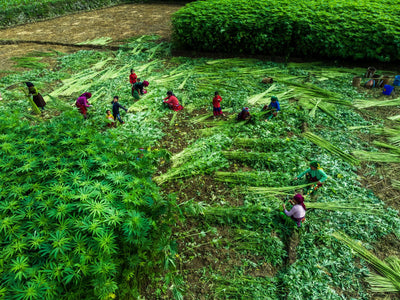
That economy is the heart of the matter. Smallholder farming families in the Rif have depended on the crop for decades despite its prohibited status, often because few other crops pay comparably on steep, dry terrain. Prohibition did not remove the farming. It left farmers exposed to legal risk and to middlemen who captured much of the profit.
In 2021 Morocco adopted Law 13-21, which legalized cannabis for medical, cosmetic and industrial purposes and created a regulatory agency to oversee the sector. Recreational use stayed illegal, and the law did not turn traditional kif smoking into a protected custom.
One stated aim of the law is to give Rif farmers a legal route into the market, supplying licensed processors rather than illicit buyers. Whether that works depends on implementation: who gets licences, how cooperatives are organized, and what prices farmers actually receive.
Thailand: Traditional Medicine Meets a Changing Law
Cannabis has a long history in Thai cooking and traditional medicine, where it appeared in remedies and in some regional dishes. That heritage was part of the argument when Thailand removed cannabis from its narcotics list in 2022, a step often described as decriminalization.
It was not full recreational legalization. The delisting opened the door to a rapid commercial boom, with shops and products appearing quickly, but the legal rules around public use, sale and the permitted THC content of extracts have shifted since. Regulators have repeatedly tried to catch up with a market that moved faster than the framework.
A 2025 change reportedly required a prescription for flower sales, and rules on who may sell and where products may be consumed have kept moving.
In Thailand, tradition supplied the justification, tourism supplied the demand, and regulation has swung between them.
For travellers, an open shop is not proof that a given purchase or use is lawful.
Custom tends to outlast statute. In each of these places the tradition was there before the modern legal category existed, and the law keeps being rewritten around it: licensed bhang in some Indian states, a tolerated festival in Kathmandu, a sacramental exemption in Jamaica, a partial opening in Morocco, a swinging door in Thailand.
Seeing locals take part openly tells a foreigner little about what is allowed, and a stall, a shop or a tolerated ritual is not a permit.
Sources
- Holi 2026: Bhang Celebration Or Health Crisis? Doctor Reveals 5 Serious Side Effects You Should Know
- How to Make Bhaang for Holi 2026? Traditional Method, Ingredients & Important Safety Tips
- Avoid bhang during Holi, warns cardiologist
- 9 Delectable Bhang Recipes Which Will Make You The Star Of Holi 2026
- How to Make Authentic Bhang Thandai for this Holi! - Pan Macmillan
- Bhang