Stopping Powdery Mildew on Gelato When Nights Drop Below 60°F
Photo via Pexels.
Every year around week 7 of flower, someone posts a photo of a gorgeous deep-purple Gelato cola dusted with what looks like powdered sugar, asking whether it's trichomes catching the light or something worse. It's almost always something worse. The instinct then is to blame the cold-night trick that pulled that color out in the first place, and to conclude you have to choose between vivid purple bag appeal and a clean, mildew-free room. That's the wrong frame entirely. Powdery mildew on cold-shocked Gelato phenotypes isn't a genetics problem or a color problem -- it's a climate control problem, and it has a specific, fixable mechanism behind it. Once you understand what's actually happening in the hour after lights-off, you can keep the anthocyanin production and lose the mildew.
This isn't about giving up on pushing color, and it isn't about running a warmer, safer, duller room out of fear. It's about recognizing that the standard cold-shock protocol, done without a corresponding humidity strategy, manufactures the exact condensation window this pathogen needs. Fix that window and the rest of the risk becomes manageable.
Why Gelato Genetics Run Hotter Risk

Photo by Leo_Visions via Unsplash.
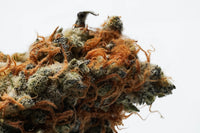
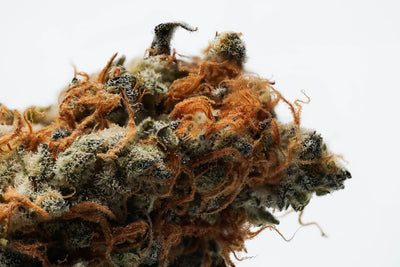
Gelato and its more color-forward cuts, Gelato #33 in particular, get flagged by breeders and seed banks as moderate-to-high risk for powdery mildew and botrytis, and it's not superstition. The structure is the issue: dense, tightly packed colas with short internode spacing that leaves almost no air gap between bud sites. That architecture is gorgeous on a scale, but it also traps humidity right where fungal spores want to sit, shielded from airflow and slow to dry out after any moisture event. This is baseline risk, present in a well-run 75F room with rock-steady humidity, before you ever touch the thermostat at lights-off. Most of that inherent risk gets neutralized by fundamentals that have nothing to do with temperature swings: real airflow moving through the canopy and not just across the tops of the plants, aggressive defoliation to open up those tight internodes, a genuinely clean grow space with no standing organic debris for spores to overwinter in, and irrigation that doesn't leave the root zone saturated and the microclimate humid. Growers who skip these basics are fighting mildew on hard mode regardless of what they do with night temperatures. Where Gelato phenotypes get themselves into real trouble is the color chase. Purple expression in this family responds strongly to environmental stress, and the fastest lever growers reach for is a hard nighttime temperature drop in late flower to suppress chlorophyll and let anthocyanins show. That's a legitimate technique. It's also precisely the practice that creates the cold-shock condensation risk this whole article is about. The genetics didn't cause the outbreak -- the environmental push for color did, layered on top of a structure that was already vulnerable. One thing worth saying plainly: starting from quality, well-bred seed stock matters more here than growers give it credit for. Vigorous genetics with strong natural resistance and even growth patterns give you margin when you're deliberately stressing the plant for color. Weak or inconsistent stock has less reserve to draw on, and that's where a cold-shock protocol turns from a controlled push into an outbreak.The Pathogen: What's Actually Growing on Your Plants
Powdery mildew on cannabis is caused by an obligate biotrophic fungus, Golovinomyces ambrosiae, meaning it can only feed on living plant tissue -- it's not decomposing dead material like a saprophyte, it's actively parasitizing your canopy while the plant is still growing. Podosphaera macularis has also been implicated in some documented outbreaks, so there's more than one organism capable of producing that familiar white dusting, though G. ambrosiae is the dominant one growers are dealing with in most facilities. The taxonomy here shifted fairly recently. A 2020 revision led by Qiu and colleagues consolidated several older species names -- including what used to be called G. spadiceus and G. cichoracearum on cannabis -- under the single name G. ambrosiae. That reclassification has since been confirmed in regional first-reports, including a 2022 confirmation in Quebec and separate identification work out of Oregon, so this isn't a fringe reinterpretation; it's become the accepted framework for talking about cannabis powdery mildew across North America. More recent research has pushed into genomics rather than taxonomy. A study published in BMC Genomics in May 2026 completed a hybrid genome assembly of G. ambrosiae and identified a set of candidate effector proteins known as RALPH genes -- proteins the fungus likely uses to suppress the plant's immune response and establish infection. That's genuinely interesting groundwork for future breeding of resistant cultivars, but it's research-stage science happening in a lab, not something that changes anything about how you run your flower room this season. The detail that should actually change your thinking is this: unlike botrytis or root-zone pathogens, powdery mildew doesn't need free liquid water on a leaf surface to germinate. Its spores can initiate infection at relative humidity below 50 percent almost as readily as above 95 percent. That kills the common assumption that keeping humidity low is inherently protective. Low ambient RH doesn't make you safe if the actual leaf surface briefly sits at or near its dew point, which is exactly what happens during a rapid temperature drop.The Real Trigger Isn't Cold -- It's the Swing

Photo via Pexels.
Here's the frustrating part: you cannot simply grow your way out of this pathogen's comfort zone. G. ambrosiae thrives across roughly 68 to 86F, and that range overlaps almost exactly with the temperatures Gelato phenotypes want during flower. There's no thermal safe zone where the plant is happy and the fungus isn't -- your target flowering environment and the mildew's ideal growth range are the same environment. What actually creates the outbreak isn't the cold itself. It's the transition. When lights shut off, warm, moisture-loaded air starts cooling rapidly. Air holds less water vapor as it cools, so as that lights-off drop happens, relative humidity spikes even though the absolute amount of moisture in the room hasn't changed. Leaf surfaces, especially in the dense inner canopy of a Gelato plant, can briefly hit their dew point during this window -- a few minutes of surface condensation that never shows up if you're just glancing at a wall-mounted humidity gauge once an hour. That brief condensation event, not steady cool nighttime temperatures, is what the fungus is built to exploit. Spores germinate fast once they sense that surface moisture, and they don't need it to last long. A five- or ten-minute window at the wrong dew point, repeated night after night through a multi-week flowering run, is enough to establish colonies that show up as visible mildew a week or two later. Which brings us to the practice that manufactures this risk on purpose: dropping dark-period temperatures to 55-60F for the final 7 to 10 days of flower specifically to inhibit chlorophyll production and push anthocyanin expression for color. It works for color. It also means you're deliberately engineering a large, fast temperature swing every single night, right when the room's air is most saturated with the moisture that hour's worth of transpiration and evaporation has added. Done without a matching humidity strategy, this protocol isn't just risky -- it's a nightly invitation.Managing by VPD, Not Flat Humidity Numbers

Minimum recommended VPD rises from 0.8 kPa in vegetative growth to 1.0 kPa during flowering, both well above the 0.6 kPa danger zone threshold that increases powdery mildew risk in grapes.
The mistake most growers make is chasing a flat relative humidity number -- 50 percent, say -- as if it means the same thing regardless of temperature. It doesn't. Warm air at 85F can hold far more water vapor than cool air at 65F, so 50% RH at those two temperatures represents very different actual moisture loads and very different levels of stress on the plant and risk to your canopy. A flat RH target is exactly the kind of metric that fails you during a nighttime temperature swing, because the number can look fine on your controller while the underlying vapor pressure deficit is doing something dangerous. VPD -- vapor pressure deficit -- solves this because it accounts for both temperature and humidity together, giving you the actual drying power of the air rather than a raw humidity percentage. As a baseline, aim for VPD above 0.8 kPa during vegetative growth and above 1.0 kPa through flower. These aren't arbitrary numbers; they reflect the range where transpiration functions normally and the plant is pulling moisture through itself at a healthy rate, which keeps leaf surfaces actively drying rather than sitting wet. The number that matters most for mildew prevention specifically is the floor. Below roughly 0.6 kPa VPD, plants close their stomata and transpiration effectively stops. That's the low-VPD danger zone, and it's precisely the condition that favors both botrytis and powdery mildew during flower -- still air, high moisture, no active drying happening at the leaf surface. If your cold-shock protocol is dropping you into sub-0.6 kPa territory even briefly, you're building the outbreak whether or not the thermostat readout looks reasonable. The practical shift this demands is continuous tracking, not spot-checking. Most growers glance at their environment during the day and assume the night takes care of itself. The actual danger window is short and clusters tightly around the lights-off transition -- which means a controller or logger that captures VPD through the full 24-hour cycle, not just at lights-on when you happen to be in the room, is the only way to actually see the problem before it becomes visible on a leaf.Practical Fixes for Cold-Night Flower Rooms
Dehumidification, not heating, is the primary tool here, and growers who reach for a space heater when night temps drop are usually solving the wrong variable. A mature flowering canopy transpires several liters of water per day depending on plant count and size, and that moisture load doesn't disappear just because lights are off -- it has to be pulled out of the air mechanically, or it sits there waiting for the temperature to drop far enough to condense. Sizing matters more than most people budget for. An undersized dehumidifier is the single most common reason growers still see humidity spikes during a cold-shock night even though they technically own a dehumidifier. Size the unit to your canopy's actual transpiration load and room volume, not just square footage on the tent's spec sheet -- a flowering room packed with dense Gelato colas is transpiring far more than the same footprint of young vegging plants, and the dehumidifier needs headroom to keep pace with that load as temperatures fall, not just handle it at steady state. Once VPD is dipping into that sub-0.6 kPa danger zone, the secondary correction is raising leaf and canopy temperature slightly, not abandoning the cold-shock protocol altogether. Gentle supplemental heat, or simply softening how aggressively and how fast you drop the dark-period temperature, buys back VPD headroom without erasing the anthocyanin-triggering stress you're going for. Airflow is non-negotiable through the entire lights-off period, not just during the day. Oscillating fans running horizontally across the canopy prevent the still, saturated microclimate from forming in the first place -- that's the pocket of dead air deep in a dense Gelato cola where condensation forms earliest and where a fan's breeze rarely reaches unless it's deliberately aimed through the canopy rather than over it. Finally, stagger the onset of the cold shock instead of dropping temperature all at once at lights-off. A gradual ramp down over 30-60 minutes gives your dehumidifier time to respond to the changing moisture load in real time, rather than getting hit with a sudden RH spike it can't correct fast enough to matter.Scouting and Early Response
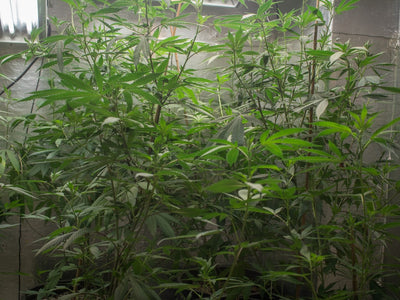
Scouting has to happen nightly during any cold-shock window, and it has to target the right spots -- the undersides of fan leaves and the tight interior bud clusters near the top of the canopy, where Gelato's dense structure traps moisture longest and airflow reaches least. Checking the tops of colas under your grow lights and calling it a scouting pass misses exactly where this pathogen establishes first. Early powdery mildew is easy to miss on purpose, not by accident. It starts as faint white dusty patches sometimes only a few millimeters across, and under typical grow lighting that subtle texture blends into normal leaf sheen unless you're looking closely and specifically for it. By the time it's obviously visible across multiple leaves during a casual walkthrough, it's already had a week or more to establish and spread spores throughout the room. When you find it, isolate and remove the infected material immediately -- don't wait to finish scouting the rest of the room, and don't wait to plan a broader treatment. Powdery mildew colonies sporulate readily once established, and every hour that infected leaf stays in the room is another chance for spores to spread on airflow to healthy tissue nearby. Bag it before you cut it if you can, and get it out of the space entirely rather than tossing it in a corner trash bin inside the tent. The last piece is sequencing your response correctly. If a humidity spike from an underpowered cold-shock protocol is the actual root cause, reaching straight for a fungicide without fixing the environmental trigger just delays the next outbreak by a week or two. Adjust the cold-shock timing, dehumidifier sizing, and airflow first. Treat the visible infection, yes, but treat it as a symptom of a fixable environmental gap, not as the whole problem.The genomic work on G. ambrosiae -- mapping its genome, cataloging those RALPH effector proteins -- points toward a future where breeders can select for cultivars with genuine resistance to this pathogen, built into the plant rather than managed around it. That future is worth paying attention to, and it's a big part of why seed companies are investing in genetics with better baseline vigor and disease resistance now, ahead of when resistance breeding matures. But it's lab-stage research. It doesn't change what you do in your flower room this cycle, and it won't for several years yet.
Until then, environmental control is the only lever that actually works, and it's a lever you already have full access to. The condensation window at lights-off is short, predictable, and entirely a function of how your dehumidifier, fans, and temperature ramp are configured relative to your canopy's real transpiration load. Growers who track VPD through the full night cycle instead of glancing at a flat humidity number, and who size their equipment to the plant load rather than the room's square footage, can run the same aggressive cold-shock color push as everyone else without handing the mildew a nightly invitation. Outcomes still depend on your specific room, your climate, and the genetics you started with -- but starting from vigorous, well-bred seed stock and pairing it with real environmental discipline is what separates a purple harvest from a moldy one.
Sources
- Grape (Vitis spp.)-Powdery Mildew | Pacific Northwest Pest Management Handbooks
- Permanent Marker Strain – Grow Guide & Genetics | Prime Cuts Nursery
- Fungicidal imidazole diphenylaliphaticboranes and derivatives thereof
- Gelato Cake Strain – Grow Guide & Genetics | Prime Cuts Nursery
- Identification of two novel powdery mildew resistance loci, Ren6 and Ren7, from the wild Chinese grape species Vitis piasezkii